
A cough that won’t quit, a fever that keeps climbing, and a tight, aching chest with every breath. Pneumonia can develop quietly over a few days or hit hard and fast, and either way it deserves prompt attention. If you’re looking for a pneumonia emergency room in Kingwood, TX, Aether Health – Kingwood ER is open 24 hours a day with on-site chest X-ray, lab testing, and IV antibiotics ready the moment you arrive. Our board-certified emergency physicians see patients within minutes, with no appointment needed.
As a freestanding emergency room, we evaluate, stabilize, and treat pneumonia on-site. If your case is severe enough to need hospital admission, we stabilize you first and coordinate the transfer.
If you or a loved one has severe difficulty breathing, bluish lips, confusion, or chest pain that worsens with every breath, call 911 or come to our ER immediately.
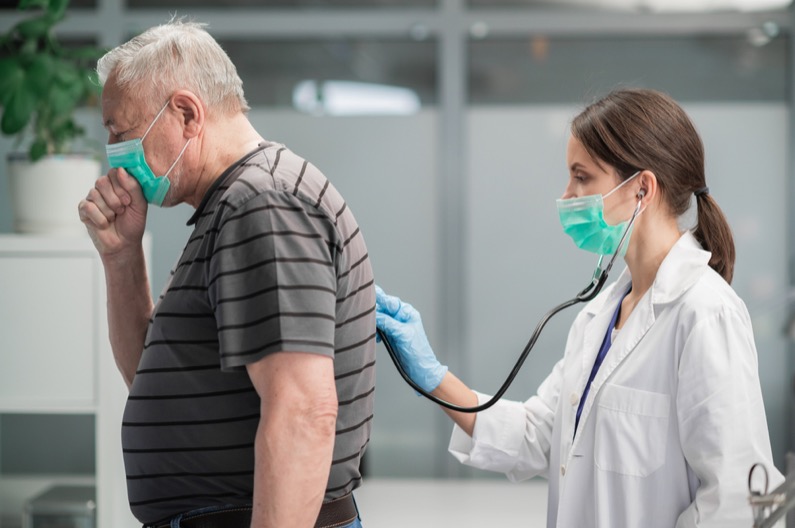
Go to the ER if you’re having trouble breathing, your fever won’t come down, your chest pain is sharp or worsens with breathing, or you feel confused or unusually weak. Mild respiratory infections often improve with rest and fluids, but pneumonia can progress quickly, especially in young children, older adults, and anyone with an underlying health condition. Signs it’s time to be seen include:
Diagnosing pneumonia usually takes a combination of a physical exam and a few key tests, most of which we can complete in a single visit:
Listening to your lungs for crackling or abnormal breath sounds that suggest fluid or inflammation.
Shows areas of infection or fluid in the lungs and is the standard way to confirm the diagnosis.
To measure how much oxygen is reaching your bloodstream.
Including a white blood cell count, to help gauge the severity and type of infection.
All of this happens on-site through our diagnostic imaging and laboratory services, so you get answers the same visit rather than waiting days for results.
Treatment depends on how severe the infection is and how well you’re breathing, but generally includes:
Many patients with mild to moderate pneumonia are treated and discharged with oral antibiotics and a clear follow-up plan. Patients with more severe infections, low oxygen levels, or complicating health conditions may need a higher level of care, and we’ll coordinate that transfer if it’s necessary.

Walking pneumonia is a milder form of pneumonia, usually caused by different and less aggressive organisms, that allows most people to stay on their feet and manage daily activities despite the infection. Typical pneumonia tends to hit harder, with a higher fever, more pronounced fatigue, and a cough that’s often more productive. Walking pneumonia can still cause a lingering cough, mild fever, and tiredness for weeks, and while it’s usually less dangerous, it isn’t harmless. It can still spread to others and, in some cases, worsen if untreated, particularly in people with weaker immune systems.
Pneumonia is treated as a higher-risk emergency in older adults, because the classic symptoms often don’t show up the way they do in younger patients. Instead of a high fever and forceful cough, an older adult with pneumonia may show confusion, unusual weakness, a lower-than-normal body temperature, or a general decline in alertness and appetite. These subtler signs are easy to miss or mistake for normal aging, which is part of why pneumonia remains a leading cause of hospitalization among seniors. If an older family member seems suddenly more confused, weaker, or simply not themselves, along with any breathing changes, it’s worth an ER evaluation rather than waiting to see if it passes.
In children, watch for fast or labored breathing, visible pulling in at the ribs or neck with each breath, bluish lips, poor feeding, or unusual lethargy. Young children may not be able to describe chest pain or breathlessness, so caregivers often have to rely on how the child looks and acts. Our team provides pediatric emergency care around the clock and is experienced in recognizing respiratory distress in infants and young children, whose pneumonia can progress faster than in older kids or adults.
Many cases of pneumonia can be managed outside the hospital, especially when they’re caught early and the patient is otherwise healthy. Factors that typically determine whether outpatient treatment is appropriate include:
| Favors Outpatient Treatment | Favors Hospital-Level Care |
|---|---|
| Normal or near-normal oxygen levels | Low oxygen levels needing ongoing support |
| Able to keep fluids and food down | Unable to tolerate oral intake or medication |
| Generally healthy with no major conditions | Underlying heart, lung, or immune conditions |
| Stable vital signs, alert and oriented | Confusion, rapid heart rate, or unstable vital signs |
| Reliable support at home for follow-up care | Limited ability to monitor symptoms at home |
Our physicians make this determination based on your exam, imaging, and lab results, and will walk you through the reasoning either way.
365 days a year.
On-site chest X-ray and lab testing for same-visit diagnosis.
IV antibiotics, oxygen therapy, and IV fluids available immediately.
Experienced with pneumonia in all age groups.
Average 1-3 minutes to see a doctor, no appointment needed.
Most PPO insurance accepted - see our insurance and billing information.
We serve Kingwood, Humble, Atascocita, Porter, and Northeast Houston from our facility on Northpark Drive, just off Highway 59/I-69.
Go to the ER if you’re struggling to breathe, your fever is high or persistent, you have sharp chest pain, or you feel confused or unusually weak. These signs suggest the infection needs prompt evaluation and treatment.
Diagnosis typically combines a physical exam, a chest X-ray to look for infection or fluid in the lungs, a pulse oximetry reading, and blood work to assess the severity of the infection.
Treatment may include IV antibiotics, oxygen therapy if your levels are low, IV fluids for dehydration, and breathing treatments if wheezing is present, along with fever and pain management.
Walking pneumonia is a milder form that allows most people to continue daily activities, usually with a lower fever and less severe symptoms than typical pneumonia, though it can still linger for weeks.
Yes, pneumonia is treated with extra caution in older adults because symptoms often present atypically, showing up as confusion or weakness rather than a high fever, which can delay recognition.
Often, yes. Patients with normal oxygen levels, stable vital signs, and no major underlying conditions can frequently be treated with oral antibiotics and monitored at home.
Watch for fast or labored breathing, visible chest retractions, bluish lips, poor feeding, or unusual lethargy. These signs in a child warrant prompt emergency evaluation.
A cough and fever that keep climbing deserve a same-day answer. Aether Health – Kingwood ER offers 24/7 chest X-ray, lab testing, and IV treatment for pneumonia in Kingwood, TX, with no appointment needed.
Call now: (713) 528-8703 | Visit us: 2158 Northpark Dr, Kingwood, TX 77339
This content is for general educational purposes and is not a substitute for professional medical advice. If you are experiencing a medical emergency, call 911 or go to the nearest emergency room.
